Notre-Dame de Paris in French, with English translation
Victor Hugo · 1831 · Opening, ~747 words · level C1 · in English: The Hunchback of Notre-Dame
Paris, 6 January 1482, the Feast of Fools: the crowd packs the great hall of the Palais de Justice to see a mystery play. Hugo’s novel of the bell-ringer Quasimodo, the dancer Esmeralda and the cathedral.
Add the whole book to your wishlist Only the opening is ready so far. Free: the books readers ask for most are the next ones we prepare in full. Read the opening in Lexico.The opening, as you read it in Lexico
The first 750 words of the French text. Tap any sentence for its English translation, then any word for its meaning: that is what the app does on every page.
Il y a aujourd'hui trois cent quarante-huit ans six mois et dix-neuf jours que les Parisiens s'éveillèrent au bruit de toutes les cloches sonnant à grande volée dans la triple enceinte de la Cité, de l'Université et de la Ville.
It has been three hundred and forty-eight years, six months and nineteen days today since the Parisians woke to the sound of all the bells pealing at full swing through the triple enclosure of the Cité, the University and the Ville.
Ce n'est cependant pas un jour dont l'histoire ait gardé souvenir que le 6 janvier 1482. Rien de notable dans l'événement qui mettait ainsi en branle, dès le matin, les cloches et les bourgeois de Paris. Ce n'était ni un assaut de Picards ou de Bourguignons, ni une châsse menée en procession, ni une révolte d'écoliers dans la vigne de Laas, ni une entrée de notre dit très redouté seigneur monsieur le roi, ni même une belle pendaison de larrons et de larronnesses à la Justice de Paris. Ce n'était pas non plus la survenue, si fréquente au quinzième siècle, de quelque ambassade chamarrée et empanachée. Il y avait à peine deux jours que la dernière cavalcade de ce genre, celle des ambassadeurs flamands chargés de conclure le mariage entre le dauphin et Marguerite de Flandre, avait fait son entrée à Paris, au grand ennui de M. le cardinal de Bourbon, qui, pour plaire au roi, avait dû faire bonne mine à toute cette rustique cohue de bourgmestres flamands, et les régaler, en son hôtel de Bourbon, d'une moult belle moralité, sotie et farce, tandis qu'une pluie battante inondait à sa porte ses magnifiques tapisseries.
Yet it is not a day that history has kept any record of: the 6th of January 1482. Nothing remarkable about the event that so set the bells and the citizens of Paris in motion from morning on. It was neither an assault by Picards or Burgundians, nor a reliquary carried in procession, nor a revolt of students in the vineyard of Laas, nor an entry of our said very dreaded lord the king, nor even a fine hanging of thieves and female thieves at the Justice of Paris. Nor was it the arrival, so frequent in the fifteenth century, of some gaudily decorated and plumed embassy. It had barely been two days since the last cavalcade of this kind, that of the Flemish ambassadors charged with arranging the marriage of the dauphin and Marguerite of Flanders, had made its entry into Paris, to the great annoyance of Monsieur the Cardinal of Bourbon, who, to please the king, had had to put a good face on all that rustic crowd of Flemish burgomasters and entertain them at his Bourbon mansion with a very fine morality play, sotie and farce, while a driving rain drenched his magnificent tapestries at his door.
Le 6 janvier, ce qui mettoit en émotion tout le populaire de Paris, comme dit Jehan de Troyes, c'était la double solennité, réunie depuis un temps immémorial, du jour des Rois et de la Fête des Fous.
On the 6th of January, what stirred up all the populace of Paris, as Jehan de Troyes says, was the double solemnity, long united, of Twelfth Night and the Feast of Fools.
Ce jour-là, il devait y avoir feu de joie à la Grève, plantation de mai à la chapelle de Braque et mystère au Palais de Justice. Le cri en avait été fait la veille à son de trompe dans les carrefours, par les gens de M. le prévôt, en beaux hoquetons de camelot violet, avec de grandes croix blanches sur la poitrine.
That day, there was to be a bonfire at the Grève, a May tree planting at the chapel of Braque, and a mystery play at the Palais de Justice. The proclamation had been made the day before with the sound of trumpets at the crossroads, by the men of the provost, in fine tabards of violet camlet, with large white crosses on the chest.
La foule des bourgeois et des bourgeoises s'acheminait donc de toutes parts dès le matin, maisons et boutiques fermées, vers l'un des trois endroits désignés. Chacun avait pris parti, qui pour le feu de joie, qui pour le mai, qui pour le mystère. Il faut dire, à l'éloge de l'antique bon sens des badauds de Paris, que la plus grande partie de cette foule se dirigeait vers le feu de joie, lequel était tout à fait de saison, ou vers le mystère, qui devait être représenté dans la grand-salle du Palais bien couverte et bien close, et que les curieux s'accordaient à laisser le pauvre mai mal fleuri grelotter tout seul sous le ciel de janvier dans le cimetière de la chapelle de Braque.
So the crowd of citizens, men and women, made its way from every direction from morning on, houses and shops shut, toward one of the three designated places. Each had chosen a side: some for the bonfire, some for the May tree, some for the mystery play. It must be said, to the praise of the ancient good sense of the Paris gawkers, that most of this crowd was heading toward the bonfire, which was perfectly in season, or toward the mystery play, which was to be performed in the great hall of the Palais, well roofed and well enclosed, and that the curious agreed to leave the poor badly flowered May tree to shiver all alone under the January sky in the cemetery of the chapel of Braque.
Le peuple affluait surtout dans les avenues du Palais de Justice, parce qu'on savait que les ambassadeurs flamands, arrivés de la surveille, se proposaient d'assister à la représentation du mystère et à l'élection du pape des fous, laquelle devait se faire également dans la grand-salle.
The people flocked especially to the avenues of the Palais de Justice, because it was known that the Flemish ambassadors, who had arrived the day before, intended to attend the performance of the mystery play and the election of the Pope of Fools, which was also to take place in the great hall.
Ce n'était pas chose aisée de pénétrer ce jour-là dans cette grand-salle, réputée cependant alors la plus grande enceinte couverte qui fût au monde (il est vrai que Sauval n'avait pas encore mesuré la grande salle du château de Montargis). La place du Palais, encombrée de peuple, offrait aux curieux des fenêtres l'aspect d'une mer, dans laquelle cinq ou six rues, comme autant d'embouchures de fleuves, dégorgeaient à chaque instant de nouveaux flots de têtes. Les ondes de cette foule, sans cesse grossies, se heurtaient aux angles des maisons qui s'avançaient çà et là, comme autant de promontoires, dans le bassin irrégulier de la place. Au centre de la haute façade gothique du Palais, le grand escalier, sans relâche remonté et descendu par un double courant qui, après s'être brisé sous le perron intermédiaire, s'épandait à larges vagues sur ses deux pentes latérales, le grand escalier, dis-je, ruisselait incessamment dans la place comme une cascade dans un lac. Les cris, les rires, le trépignement de ces mille pieds faisaient un grand bruit et une grande clameur. De temps en temps cette clameur et ce bruit redoublaient, le courant qui poussait toute cette foule vers le grand escalier rebroussait, se troublait, tourbillonnait. C'était une bourrade d'un archer ou le cheval d'un sergent de la prévôté qui ruait pour rétablir l'ordre; admirable tradition que la prévôté a léguée à la connétablie, la connétablie à la maréchaussée, et la maréchaussée à notre gendarmerie de Paris.
It was no easy matter to get into the great hall that day, though it was then considered the largest covered enclosure in the world (it is true that Sauval had not yet measured the great hall of the château of Montargis). The square of the Palais, crowded with people, offered the onlookers at the windows the appearance of a sea, into which five or six streets, like so many river mouths, kept disgorging new waves of heads at every moment. The waves of this crowd, ceaselessly swelling, dashed against the corners of the houses that jutted out here and there like so many headlands into the irregular basin of the square. At the centre of the high Gothic façade of the Palais, the great staircase, unceasingly climbed and descended by a double current that, after breaking against the middle landing, spread out in broad waves over its two side slopes, the great staircase, I say, streamed ceaselessly into the square like a cascade into a lake. The shouts, the laughter, the stamping of those thousand feet made a great din and a great clamor. From time to time this clamor and this noise redoubled, and the current that was pushing the whole crowd toward the great staircase turned back, grew confused, and swirled. It was a shove from an archer or the horse of a sergeant of the provost's guard, kicking to restore order; an admirable tradition that the provost's guard bequeathed to the constabulary, the constabulary to the mounted police, and the mounted police to our Paris gendarmerie.
Want the rest? Lexico has the opening of Notre-Dame de Paris so far. Add the book to your wishlist: the titles readers ask for most are the next ones we prepare in full, with the same sentence-by-sentence translation, every word explained in context, and flashcards from the words you look up.
Add the whole book to your wishlistWords from this passage
20 words from the opening worth knowing for the rest of the book, with the meaning they have here.
| French | English |
|---|---|
| l’an | year |
| le mois | month |
| le parisien | Parisians |
| éveiller | to stimulate |
| le bruit | noise (here: sound) |
| la cloche | bell |
| sonner | to sound |
| la volée | swing |
| l’enceinte | enclosure, compound |
| l’université | university |
| l’histoire | history |
| garder | to keep |
| le souvenir | memory |
| le janvier | January |
| notable | remarkable |
| l’événement | event |
| mettre | to set |
| le branle | motion |
| le matin | morning |
| le bourgeois | citizens |
More French books with English translation
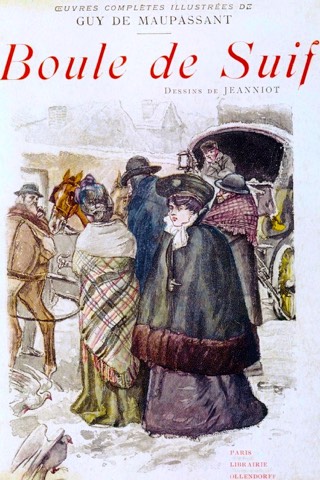
Boule de Suif
Guy de Maupassant · 1880 · ~10,500 words · level B2 · in English: Ball of Fat
During the Franco-Prussian War, a coach of respectable citizens flees occupied Rouen together with a prostitute nicknamed Boule de Suif, and their gratitude to her does not last. The story that made Maupassant famous.
Bel-Ami
Guy de Maupassant · 1885 · Chapter 1, ~5,000 words · level B2
Georges Duroy, a penniless former soldier, arrives in Paris and climbs through journalism and the beds of well-connected women. Maupassant’s novel of ambition.
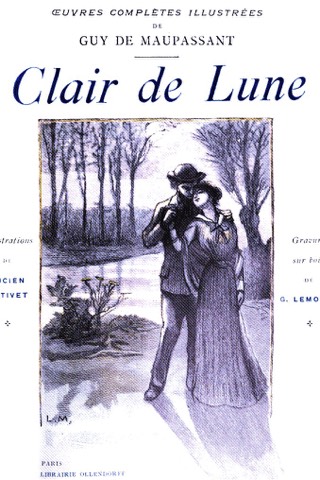
Clair de lune
Guy de Maupassant · 1884 · ~24,500 words · level B2 · in English: Moonlight
Three stories from Maupassant’s collection: “Clair de lune”, in which a priest who distrusts women sets out to catch his niece with her lover, “Conte de Noël” and “Mademoiselle Cocotte”.
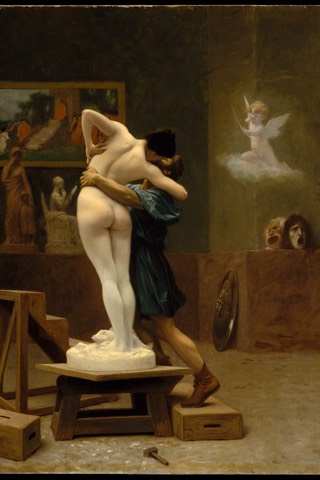
La Vénus d'Ille
Prosper Mérimée · 1837 · ~10,500 words · level B2–C1 · in English: The Venus of Ille
An antiquarian visits a village in Roussillon where a bronze Venus has just been dug up, a few days before his host’s son is to be married. Mérimée’s tale of the fantastic, told with a straight face.