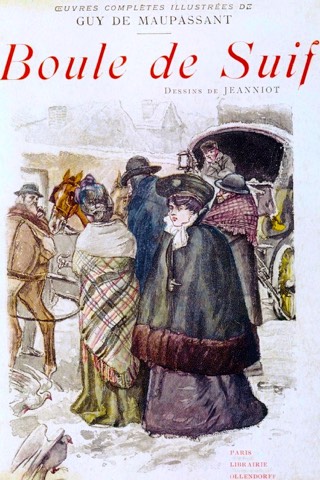
Boule de Suif in French, with English translation
Guy de Maupassant · 1880 · ~10,500 words · level B2 · in English: Ball of Fat
During the Franco-Prussian War, a coach of respectable citizens flees occupied Rouen together with a prostitute nicknamed Boule de Suif, and their gratitude to her does not last. The story that made Maupassant famous.
Read the whole book free in Lexico In your browser. Tap any word for its meaning and keep it as a flashcard.The opening, as you read it in Lexico
The first 750 words of the French text. Tap any sentence for its English translation, then any word for its meaning: that is what the app does on every page.
Pendant plusieurs jours de suite des lambeaux d'armée en déroute avaient traversé la ville. Ce n'était point de la troupe, mais des hordes débandées. Les hommes avaient la barbe longue et sale, des uniformes en guenilles, et ils avançaient d'une allure molle, sans drapeau, sans régiment. Tous semblaient accablés, éreintés, incapables d'une pensée ou d'une résolution, marchant seulement par habitude, et tombant de fatigue sitôt qu'ils s'arrêtaient. On voyait surtout des mobilisés, gens pacifiques, rentiers tranquilles, pliant sous le poids du fusil; des petits moblots alertes, faciles à l'épouvante et prompts à l'enthousiasme, prêts à l'attaque comme à la fuite; puis, au milieu d'eux, quelques culottes rouges, débris d'une division moulue dans une grande bataille; des artilleurs sombres alignés avec des fantassins divers; et, parfois, le casque brillant d'un dragon au pied pesant qui suivait avec peine la marche plus légère des lignards.
For several consecutive days ragged remnants of a routed army had crossed the city. It was not troops, but scattered hordes. The men had long, dirty beards, uniforms in tatters, and they advanced at a slow pace, without flags, without a regiment. All seemed overwhelmed, exhausted, incapable of thought or decision, just walking out of habit, and falling asleep from fatigue as soon as they stopped. One mostly saw mobilized men, peaceful people, quiet rentiers, bending under the weight of the rifle; small alert moblots, easily terrified and quick to enthusiasm, ready for attack as well as for flight; then, in their midst, some red trousers, remnants of a division crushed in a great battle; dark artillerymen lined up with various infantrymen; and, sometimes, the shining helmet of a dragoon with a heavy step following with difficulty the lighter march of the foot guards.
Des légions de francs-tireurs aux appellations héroïques: «les Vengeurs de la Défaite—les Citoyens de la Tombe—les Partageurs de la Mort«—passaient à leur tour, avec des airs de bandits.
Legions of francs-tireurs with heroic names: “the Avengers of Defeat—the Citizens of the Grave—the Sharers of Death”—passed in turn, with the airs of bandits.
Leurs chefs, anciens commerçants en draps ou en graines, ex-marchands de suif ou de savon, guerriers de circonstance, nommés officiers pour leurs écus ou la longueur de leurs moustaches, couverts d'armes, de flanelle et de galons, parlaient d'une voix retentissante, discutaient plans de campagne, et prétendaient soutenir seuls la France agonisante sur leurs épaules de fanfarons; mais ils redoutaient parfois leurs propres soldats, gens de sac et de corde, souvent braves à outrance, pillards et débauchés.
Their leaders, former cloth or seed merchants, ex-tallow or soap merchants, occasional warriors, named officers for their coins or the length of their mustaches, covered in weapons, flannel and braid, spoke with a ringing voice, discussed campaign plans, and claimed to bear alone the dying France on their boastful shoulders; but they sometimes feared their own soldiers, the men of sack and rope, often recklessly brave, pillagers and debauchees.
Les Prussiens allaient entrer dans Rouen, disait-on.
It was said that the Prussians were going to enter Rouen.
La Garde nationale qui, depuis deux mois, faisait des reconnaissances très prudentes dans les bois voisins, fusillant parfois ses propres sentinelles, et se préparant au combat quand un petit lapin remuait sous des broussailles, était rentrée dans ses foyers. Ses armes, ses uniformes, tout son attirail meurtrier, dont elle épouvantait naguère les bornes des routes nationales à trois lieues à la ronde, avaient subitement disparu.
The National Guard, which for two months had conducted very cautious reconnaissance in the nearby woods, sometimes shooting its own sentinels, and preparing for combat when a little rabbit stirred under some bushes, had returned to its homes. Its weapons, uniforms, all its deadly equipment, with which it recently terrified the boundaries of the national roads within a three-league radius, had suddenly disappeared.
Les derniers soldats français venaient enfin de traverser la Seine pour gagner Pont-Audemer par Saint-Sever et Bourg-Achard; et, marchant après tous, le général, désespéré, ne pouvant rien tenter avec ces loques disparates, éperdu lui-même dans la grande débâcle d'un peuple habitué à vaincre et désastreusement battu malgré sa bravoure légendaire, s'en allait à pied, entre deux officiers d'ordonnance.
The last French soldiers had finally crossed the Seine to reach Pont-Audemer by Saint-Sever and Bourg-Achard; and, walking after everyone, the general, desperate, unable to do anything with these disparate rags, himself distraught in the great rout of a people accustomed to victory and disastrously beaten despite their legendary bravery, was going away on foot, between two order officers.
Puis un calme profond, une attente épouvantée et silencieuse avaient plané sur la cité. Beaucoup de bourgeois bedonnants, émasculés par le commerce, attendaient anxieusement les vainqueurs, tremblant qu'on ne considérât comme une arme leurs broches à rôtir ou leurs grands couteaux de cuisine.
Then a deep calm, a terrified and silent waiting hung over the city. Many pot-bellied bourgeois, emasculated by commerce, anxiously awaited the victors, trembling that their roasting spits or large kitchen knives might be regarded as weapons.
La vie semblait arrêtée; les boutiques étaient closes, la rue muette. Quelquefois un habitant, intimidé par ce silence, filait rapidement le long des murs.
Life seemed to have stopped; the shops were closed, the street silent. Sometimes a resident, intimidated by this silence, quickly slipped along the walls.
L'angoisse de l'attente faisait désirer la venue de l'ennemi.
The anxiety of waiting made one wish for the enemy's arrival.
Dans l'après-midi du jour qui suivit le départ des troupes françaises, quelques uhlans, sortis on ne sait d'où, traversèrent la ville avec célérité. Puis, un peu plus tard, une masse noire descendit de la côte Sainte-Catherine, tandis que deux autres flots envahisseurs apparaissaient par les routes de Darnetal et de Boisguillaume. Les avant-gardes des trois corps, juste au même moment, se joignirent sur la place de l'Hôtel-de-Ville; et par toutes les rues voisines, l'armée allemande arrivait, déroulant ses bataillons qui faisaient sonner les pavés sous leur pas dur et rythmé.
In the afternoon of the day following the departure of the French troops, some uhlans, coming from who knows where, crossed the town quickly. Then, a little later, a black mass descended from Sainte-Catherine hill, while two other invading waves appeared by the roads of Darnetal and Boisguillaume. The vanguards of the three corps, at exactly the same moment, joined each other in the Hôtel-de-Ville square; and by all the nearby streets, the German army arrived, unfolding its battalions that made the cobblestones ring under their hard, rhythmic steps.
Des commandements criés d'une voix inconnue et gutturale montaient le long des maisons qui semblaient mortes et désertes, tandis que, derrière les volets fermés, des yeux guettaient ces hommes victorieux, maîtres de la cité, des fortunes et des vies, de par le «droit de guerre». Les habitants, dans leurs chambres assombries, avaient l'affolement que donnent les cataclysmes, les grands bouleversements meurtriers de la terre, contre lesquels toute sagesse et toute force sont inutiles. Car la même sensation reparaît chaque fois que l'ordre établi des choses est renversé, que la sécurité n'existe plus, que tout ce que protégeaient les lois des hommes ou celles de la nature, se trouve à la merci d'une brutalité inconsciente et féroce. Le tremblement de terre écrasant sous les maisons croulantes un peuple entier; le fleuve débordé qui roule les paysans noyés avec les cadavres des boeufs et les poutres arrachées aux toits, ou l'armée glorieuse massacrant ceux qui se défendent, emmenant les autres prisonniers, pillant au nom du Sabre et remerciant un Dieu au son du canon, sont autant de fléaux effrayants qui déconcertent toute croyance à la justice éternelle, toute la confiance qu'on nous enseigne en la protection du Ciel et en la raison de l'homme.
Commands shouted in an unknown, guttural voice rose along the houses that seemed dead and deserted, while behind the closed shutters, eyes watched these victorious men, masters of the city, fortunes, and lives, by the "law of war." The inhabitants, in their darkened rooms, had the panic caused by cataclysms, the great murderous upheavals of the earth, against which all wisdom and all strength are useless. Because the same feeling reappears every time the established order of things is overturned, security no longer exists, and everything protected by man's laws or those of nature is at the mercy of unconscious and ferocious brutality. The earthquake crushing an entire people under collapsing houses; the flooded river that rolls drowned peasants with the corpses of oxen and beams torn from roofs; or the glorious army massacring those who defend themselves, taking others prisoner, pillaging in the name of the Sword and thanking a God to the sound of cannon, are all terrifying scourges that unsettle all belief in eternal justice, all the trust taught to us in the protection of Heaven and in human reason.
Keep reading. The rest of Boule de Suif is free in Lexico, with the same sentence-by-sentence translation, every word explained in context, and flashcards from the words you look up.
Continue in LexicoWords from this passage
20 words from the opening worth knowing for the rest of the book, with the meaning they have here.
| French | English |
|---|---|
| la suite | result (here: in succession) |
| l’armée | army |
| traverser | to cross, to go across |
| la troupe | troop |
| la barbe | beard |
| sale | dirty |
| l’uniforme | uniform |
| avancer | to advance, to go forward |
| la pensée | thought |
| la fatigue | fatigue, weariness |
| arrêter | to stop, to cease |
| le fusil | rifle, gun |
| l’épouvante | terror |
| prêt | ready |
| l’attaque | attack |
| le milieu | middle |
| la culotte | breeches, trousers |
| rouge | red |
| moudre | to grind |
| la bataille | battle |
More French books with English translation
Bel-Ami
Guy de Maupassant · 1885 · Chapter 1, ~5,000 words · level B2
Georges Duroy, a penniless former soldier, arrives in Paris and climbs through journalism and the beds of well-connected women. Maupassant’s novel of ambition.
Clair de lune
Guy de Maupassant · 1884 · ~24,500 words · level B2 · in English: Moonlight
Three stories from Maupassant’s collection: “Clair de lune”, in which a priest who distrusts women sets out to catch his niece with her lover, “Conte de Noël” and “Mademoiselle Cocotte”.
La Vénus d'Ille
Prosper Mérimée · 1837 · ~10,500 words · level B2–C1 · in English: The Venus of Ille
An antiquarian visits a village in Roussillon where a bronze Venus has just been dug up, a few days before his host’s son is to be married. Mérimée’s tale of the fantastic, told with a straight face.