Les Misérables in French, with English translation
Victor Hugo · 1862 · Opening, ~663 words · level B2–C1
The convict Jean Valjean, the bishop who buys his soul for God, the policeman who hunts him and the child he rescues. Hugo’s novel begins with the bishop: Monsieur Myriel, of Digne.
Add the whole book to your wishlist Only the opening is ready so far. Free: the books readers ask for most are the next ones we prepare in full. Read the opening in Lexico.The opening, as you read it in Lexico
The first 650 words of the French text. Tap any sentence for its English translation, then any word for its meaning: that is what the app does on every page.
En 1815, M. Charles-François-Bienvenu Myriel était évêque de Digne. C'était un vieillard d'environ soixante-quinze ans; il occupait le siège de Digne depuis 1806.
In 1815, Monsieur Charles-François-Bienvenu Myriel was Bishop of Digne. He was an old man of about seventy-five; he had occupied the see of Digne since 1806.
Quoique ce détail ne touche en aucune manière au fond même de ce que nous avons à raconter, il n'est peut-être pas inutile, ne fût-ce que pour être exact en tout, d'indiquer ici les bruits et les propos qui avaient couru sur son compte au moment où il était arrivé dans le diocèse. Vrai ou faux, ce qu'on dit des hommes tient souvent autant de place dans leur vie et surtout dans leur destinée que ce qu'ils font. M. Myriel était fils d'un conseiller au parlement d'Aix; noblesse de robe. On contait de lui que son père, le réservant pour hériter de sa charge, l'avait marié de fort bonne heure, à dix-huit ou vingt ans, suivant un usage assez répandu dans les familles parlementaires. Charles Myriel, nonobstant ce mariage, avait, disait-on, beaucoup fait parler de lui. Il était bien fait de sa personne, quoique d'assez petite taille, élégant, gracieux, spirituel; toute la première partie de sa vie avait été donnée au monde et aux galanteries. La révolution survint, les événements se précipitèrent, les familles parlementaires décimées, chassées, traquées, se dispersèrent. M. Charles Myriel, dès les premiers jours de la révolution, émigra en Italie. Sa femme y mourut d'une maladie de poitrine dont elle était atteinte depuis longtemps. Ils n'avaient point d'enfants. Que se passa-t-il ensuite dans la destinée de M. Myriel? L'écroulement de l'ancienne société française, la chute de sa propre famille, les tragiques spectacles de 93, plus effrayants encore peut-être pour les émigrés qui les voyaient de loin avec le grossissement de l'épouvante, firent-ils germer en lui des idées de renoncement et de solitude? Fut-il, au milieu d'une de ces distractions et de ces affections qui occupaient sa vie, subitement atteint d'un de ces coups mystérieux et terribles qui viennent quelquefois renverser, en le frappant au coeur, l'homme que les catastrophes publiques n'ébranleraient pas en le frappant dans son existence et dans sa fortune? Nul n'aurait pu le dire; tout ce qu'on savait, c'est que, lorsqu'il revint d'Italie, il était prêtre.
Although this detail does not in any way touch the very substance of what we have to relate, it is perhaps not useless, if only to be exact in everything, to indicate here the rumors and gossip that had circulated about him at the time he arrived in the diocese. True or false, what people say about men often takes up as much room in their lives, and especially in their destiny, as what they do. Monsieur Myriel was the son of a councillor of the parlement of Aix; nobility of the robe. People used to say of him that his father, reserving him to inherit his office, had married him off very early, at eighteen or twenty, following a fairly common custom in parliamentary families. Despite this marriage, Charles Myriel had, it was said, given people much to talk about. He was well made in person, though of rather small stature, elegant, graceful, witty; the whole first part of his life had been given to society and to gallantries. The Revolution came, events came to a head, the parliamentary families, decimated, hunted down, driven out, scattered. Monsieur Charles Myriel, from the first days of the Revolution, emigrated to Italy. His wife died there of a lung disease from which she had been suffering for a long time. They had no children. What happened next in the destiny of Monsieur Myriel? The collapse of the old French society, the fall of his own family, the tragic spectacles of '93, even more frightening perhaps for the émigrés who watched them from afar through the magnifying glass of terror, did they sow in him ideas of renunciation and solitude? Was he, in the midst of one of those distractions and affections that filled his life, suddenly struck by one of those mysterious and terrible blows that sometimes come to overturn, by striking him in the heart, a man whom public catastrophes would not shake by striking him in his existence and his fortune? No one could have said; all that was known was that, when he came back from Italy, he was a priest.
En 1804, M. Myriel était curé de Brignolles. Il était déjà vieux, et vivait dans une retraite profonde.
In 1804, Monsieur Myriel was parish priest of Brignolles. He was already old, and lived in deep seclusion.
Vers l'époque du couronnement, une petite affaire de sa cure, on ne sait plus trop quoi, l'amena à Paris. Entre autres personnes puissantes, il alla solliciter pour ses paroissiens M. le cardinal Fesch. Un jour que l'empereur était venu faire visite à son oncle, le digne curé, qui attendait dans l'antichambre, se trouva sur le passage de sa majesté. Napoléon, se voyant regardé avec une certaine curiosité par ce vieillard, se retourna, et dit brusquement:
Around the time of the coronation, some small matter concerning his parish, no one quite knows what, brought him to Paris. Among other powerful people, he went to petition on behalf of his parishioners Cardinal Fesch. One day, when the emperor had come to visit his uncle, the worthy parish priest, who was waiting in the antechamber, happened to be in the path of His Majesty. Napoleon, seeing himself looked at with a certain curiosity by this old man, turned round and said abruptly:
—Quel est ce bonhomme qui me regarde?
"Who is that fellow who is looking at me?"
—Sire, dit M. Myriel, vous regardez un bonhomme, et moi je regarde un grand homme. Chacun de nous peut profiter.
"Sire," said Monsieur Myriel, "you look at a fellow, and I look at a great man." Each of us can benefit.
L'empereur, le soir même, demanda au cardinal le nom de ce curé, et quelque temps après M. Myriel fut tout surpris d'apprendre qu'il était nommé évêque de Digne.
That evening the emperor asked the cardinal for the name of this parish priest, and some time later Monsieur Myriel was quite surprised to learn that he had been appointed Bishop of Digne.
Qu'y avait-il de vrai, du reste, dans les récits qu'on faisait sur la première partie de la vie de M. Myriel? Personne ne le savait. Peu de familles avaient connu la famille Myriel avant la révolution.
Was there any truth, moreover, in the accounts that were given about the first part of Monsieur Myriel's life? Nobody knew. Few families had known the Myriel family before the Revolution.
M. Myriel devait subir le sort de tout nouveau venu dans une petite ville où il y a beaucoup de bouches qui parlent et fort peu de têtes qui pensent. Il devait le subir, quoiqu'il fût évêque et parce qu'il était évêque. Mais, après tout, les propos auxquels on mêlait son nom n'étaient peut-être que des propos; du bruit, des mots, des paroles; moins que des paroles, des palabres, comme dit l'énergique langue du midi.
Monsieur Myriel was bound to suffer the fate of every newcomer to a small town where there are many mouths that talk and very few heads that think. He had to endure it, although he was a bishop and because he was a bishop. But after all, the gossip in which people mixed his name was perhaps nothing but gossip; noise, words, talk; less than talk, palaver, as the energetic language of the south says.
Quoi qu'il en fût, après neuf ans d'épiscopat et de résidence à Digne, tous ces racontages, sujets de conversation qui occupent dans le premier moment les petites villes et les petites gens, étaient tombés dans un oubli profond. Personne n'eût osé en parler, personne n'eût même osé s'en souvenir.
Be that as it may, after nine years of episcopate and residence at Digne, all these tales, subjects of conversation that occupy small towns and small people for the first moment, had fallen into profound oblivion. No one would have dared to speak of it, no one would even have dared to remember it.
Want the rest? Lexico has the opening of Les Misérables so far. Add the book to your wishlist: the titles readers ask for most are the next ones we prepare in full, with the same sentence-by-sentence translation, every word explained in context, and flashcards from the words you look up.
Add the whole book to your wishlistWords from this passage
20 words from the opening worth knowing for the rest of the book, with the meaning they have here.
| French | English |
|---|---|
| le vieillard | old man, old person |
| l’an | year |
| occuper | to occupy, to take up |
| le siège | see |
| le détail | detail |
| toucher | to touch |
| la manière | manner, way |
| le fond | substance |
| même | very |
| raconter | to recount |
| inutile | useless, unnecessary |
| indiquer | to show, indicate |
| le bruit | noise, rumor or report |
| le propos | gossip |
| courir | to run |
| le compte | account |
| arriver | to arrive |
| le diocèse | diocese |
| vrai | true |
| faux | false |
More French books with English translation
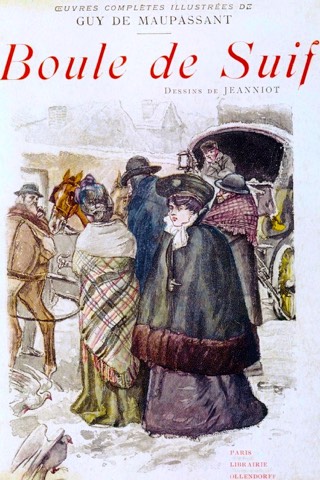
Boule de Suif
Guy de Maupassant · 1880 · ~10,500 words · level B2 · in English: Ball of Fat
During the Franco-Prussian War, a coach of respectable citizens flees occupied Rouen together with a prostitute nicknamed Boule de Suif, and their gratitude to her does not last. The story that made Maupassant famous.
Bel-Ami
Guy de Maupassant · 1885 · Chapter 1, ~5,000 words · level B2
Georges Duroy, a penniless former soldier, arrives in Paris and climbs through journalism and the beds of well-connected women. Maupassant’s novel of ambition.
Clair de lune
Guy de Maupassant · 1884 · ~24,500 words · level B2 · in English: Moonlight
Three stories from Maupassant’s collection: “Clair de lune”, in which a priest who distrusts women sets out to catch his niece with her lover, “Conte de Noël” and “Mademoiselle Cocotte”.
La Vénus d'Ille
Prosper Mérimée · 1837 · ~10,500 words · level B2–C1 · in English: The Venus of Ille
An antiquarian visits a village in Roussillon where a bronze Venus has just been dug up, a few days before his host’s son is to be married. Mérimée’s tale of the fantastic, told with a straight face.