
Le Tour du monde en quatre-vingts jours in French, with English translation
Jules Verne · 1872 · Opening, ~748 words · level B2 · in English: Around the World in Eighty Days
Phileas Fogg, a London gentleman of clockwork habits, bets his fortune that he can travel round the world in eighty days, and leaves the same evening with his new French servant, Passepartout.
Add the whole book to your wishlist Only the opening is ready so far. Free: the books readers ask for most are the next ones we prepare in full. Read the opening in Lexico.The opening, as you read it in Lexico
The first 750 words of the French text. Tap any sentence for its English translation, then any word for its meaning: that is what the app does on every page.
DANS LEQUEL PHILEAS FOGG ET PASSEPARTOUT S'ACCEPTENT RÉCIPROQUEMENT L'UN COMME MAÎTRE, L'AUTRE COMME DOMESTIQUE
IN WHICH PHILEAS FOGG AND PASSEPARTOUT ACCEPT EACH OTHER, ONE AS MASTER, THE OTHER AS SERVANT
En l'année 1872, la maison portant le numéro 7 de Saville-row, Burlington Gardens—maison dans laquelle Sheridan mourut en 1814—, était habitée par Phileas Fogg, esq., l'un des membres les plus singuliers et les plus remarqués du Reform-Club de Londres, bien qu'il semblât prendre à tâche de ne rien faire qui pût attirer l'attention.
In the year 1872, the house at number 7 Saville Row, Burlington Gardens, the house in which Sheridan died in 1814, was occupied by Phileas Fogg, Esq., one of the most singular and most noted members of the Reform Club of London, although he seemed to make it his business to do nothing that might attract attention.
À l'un des plus grands orateurs qui honorent l'Angleterre, succédait donc ce Phileas Fogg, personnage énigmatique, dont on ne savait rien, sinon que c'était un fort galant homme et l'un des plus beaux gentlemen de la haute société anglaise.
After one of the greatest orators who do honor to England, there came this Phileas Fogg, an enigmatic figure about whom nothing was known, except that he was a very gallant gentleman and one of the handsomest gentlemen of high English society.
On disait qu'il ressemblait à Byron—par la tête, car il était irréprochable quant aux pieds—, mais un Byron à moustaches et à favoris, un Byron impassible, qui aurait vécu mille ans sans vieillir.
People said he resembled Byron, in the head, for he was irreproachable as to the feet, but a Byron with moustaches and sideburns, an impassive Byron, who would have lived a thousand years without growing old.
Anglais, à coup sûr, Phileas Fogg n'était peut-être pas Londonner. On ne l'avait jamais vu ni à la Bourse, ni à la Banque, ni dans aucun des comptoirs de la Cité. Ni les bassins ni les docks de Londres n'avaient jamais reçu un navire ayant pour armateur Phileas Fogg. Ce gentleman ne figurait dans aucun comité d'administration. Son nom n'avait jamais retenti dans un collège d'avocats, ni au Temple, ni à Lincoln's-inn, ni à Gray's-inn. Jamais il ne plaida ni à la Cour du chancelier, ni au Banc de la Reine, ni à l'Échiquier, ni en Cour ecclésiastique. Il n'était ni industriel, ni négociant, ni marchand, ni agriculteur. Il ne faisait partie ni de l'Institution royale de la Grande-Bretagne, ni de l'Institution de Londres, ni de l'Institution des Artisans, ni de l'Institution Russell, ni de l'Institution littéraire de l'Ouest, ni de l'Institution du Droit, ni de cette Institution des Arts et des Sciences réunis, qui est placée sous le patronage direct de Sa Gracieuse Majesté. Il n'appartenait enfin à aucune des nombreuses sociétés qui pullulent dans la capitale de l'Angleterre, depuis la Société de l'Armonica jusqu'à la Société entomologique, fondée principalement dans le but de détruire les insectes nuisibles.
English, certainly, Phileas Fogg perhaps was not a Londoner. No one had ever seen him at the Stock Exchange, nor at the Bank, nor in any of the counting-houses of the City. Neither the basins nor the docks of London had ever received a ship having Phileas Fogg as its owner. This gentleman was not listed on any board of directors. His name had never resounded in any college of lawyers, nor at the Temple, nor at Lincoln's Inn, nor at Gray's Inn. He never pleaded either at the Court of Chancery, or at the Queen's Bench, or at the Exchequer, or in the Ecclesiastical Court. He was neither an industrialist, nor a merchant, nor a trader, nor a farmer. He was not a member of the Royal Institution of Great Britain, nor of the London Institution, nor of the Artisans' Institution, nor of the Russell Institution, nor of the Western Literary Institution, nor of the Law Institution, nor of that Institution of Arts and Sciences combined, which is placed under the direct patronage of Her Gracious Majesty. He did not belong, finally, to any of the numerous societies that swarm in the capital of England, from the Armonica Society to the Entomological Society, founded mainly with the aim of destroying harmful insects.
Phileas Fogg était membre du Reform-Club, et voilà tout.
Phileas Fogg was a member of the Reform Club, and that was all.
À qui s'étonnerait de ce qu'un gentleman aussi mystérieux comptât parmi les membres de cette honorable association, on répondra qu'il passa sur la recommandation de MM. Baring frères, chez lesquels il avait un crédit ouvert. De là une certaine «surface», due à ce que ses chèques étaient régulièrement payés à vue par le débit de son compte courant invariablement créditeur.
To whoever might wonder how so mysterious a gentleman came to be counted among the members of this honorable association, the answer is that he was admitted on the recommendation of Messrs. Baring Brothers, with whom he had an open line of credit. Hence a certain front of respectability, owing to the fact that his cheques were regularly paid on sight by debit against his current account, which was invariably in credit.
Ce Phileas Fogg était-il riche? Incontestablement. Mais comment il avait fait fortune, c'est ce que les mieux informés ne pouvaient dire, et Mr. Fogg était le dernier auquel il convînt de s'adresser pour l'apprendre. En tout cas, il n'était prodigue de rien, mais non avare, car partout où il manquait un appoint pour une chose noble, utile ou généreuse, il l'apportait silencieusement et même anonymement.
Was this Phileas Fogg rich? Undoubtedly. But how he had made his fortune is what the best-informed could not say, and Mr. Fogg was the last person it would be fitting to ask about it. In any case, he was not lavish with anything, yet not miserly either, for wherever a sum was lacking for a noble, useful or generous cause, he quietly supplied it, even anonymously.
En somme, rien de moins communicatif que ce gentleman. Il parlait aussi peu que possible, et semblait d'autant plus mystérieux qu'il était silencieux. Cependant sa vie était à jour, mais ce qu'il faisait était si mathématiquement toujours la même chose, que l'imagination, mécontente, cherchait au-delà.
In short, nothing less communicative than this gentleman. He spoke as little as possible, and seemed all the more mysterious for being silent. Yet his life was up to date, but what he did was always so mathematically the same thing that the imagination, dissatisfied, looked beyond.
Avait-il voyagé? C'était probable, car personne ne possédait mieux que lui la carte du monde. Il n'était endroit si reculé dont il ne parût avoir une connaissance spéciale. Quelquefois, mais en peu de mots, brefs et clairs, il redressait les mille propos qui circulaient dans le club au sujet des voyageurs perdus ou égarés; il indiquait les vraies probabilités, et ses paroles s'étaient trouvées souvent comme inspirées par une seconde vue, tant l'événement finissait toujours par les justifier. C'était un homme qui avait dû voyager partout,—en esprit, tout au moins.
Had he travelled? That was likely, for no one knew the map of the world better than he did. There was no place so remote that he did not seem to have a special knowledge of it. Sometimes, but in few words, brief and clear, he would set straight the many rumors circulating in the club about lost or strayed travelers; he pointed out the true probabilities, and his words had often seemed inspired, as if by second sight, so much did events always end up justifying them. He was a man who must have travelled everywhere, in spirit at least.
Ce qui était certain toutefois, c'est que, depuis de longues années, Phileas Fogg n'avait pas quitté Londres. Ceux qui avaient l'honneur de le connaître un peu plus que les autres attestaient que—si ce n'est sur ce chemin direct qu'il parcourait chaque jour pour venir de sa maison au club—personne ne pouvait prétendre l'avoir jamais vu ailleurs. Son seul passe-temps était de lire les journaux et de jouer au whist. À ce jeu du silence, si bien approprié à sa nature, il gagnait souvent, mais ses gains n'entraient jamais dans sa bourse et figuraient pour une somme importante à son budget de charité. D'ailleurs, il faut le remarquer, Mr. Fogg jouait évidemment pour jouer, non pour gagner. Le jeu était pour lui un combat, une lutte contre une difficulté, mais une lutte sans mouvement, sans déplacement, sans fatigue, et cela allait à son caractère.
What was certain, however, is that for many long years Phileas Fogg had not left London. Those who had the honor of knowing him a little better than others attested that, except on the direct path he walked every day from his house to the club, no one could claim to have ever seen him elsewhere. His only pastime was to read the newspapers and to play whist. At this game of silence, so well suited to his nature, he often won, but his winnings never went into his purse and counted for a considerable sum in his charity budget. Moreover, it must be noted, Mr. Fogg obviously played for the sake of playing, not to win. For him the game was a combat, a struggle against a difficulty, but a struggle without movement, without displacement, without fatigue, and this suited his character.
Want the rest? Lexico has the opening of Le Tour du monde en quatre-vingts jours so far. Add the book to your wishlist: the titles readers ask for most are the next ones we prepare in full, with the same sentence-by-sentence translation, every word explained in context, and flashcards from the words you look up.
Add the whole book to your wishlistWords from this passage
20 words from the opening worth knowing for the rest of the book, with the meaning they have here.
| French | English |
|---|---|
| accepter | to accept |
| le maître | master |
| le domestique | servant |
| l’année | year |
| la maison | house |
| porter | to support, to bear |
| le numéro | number |
| mourir | to die |
| habiter | to live in, to occupy |
| le membre | member |
| singulier | singular |
| remarqué | noted |
| sembler | to appear, to seem |
| prendre | to make |
| la tâche | task |
| pouvoir | can, to be able to |
| attirer | to attract |
| grand | great |
| l’orateur | orator |
| honorer | to honor, to honour |
More French books with English translation
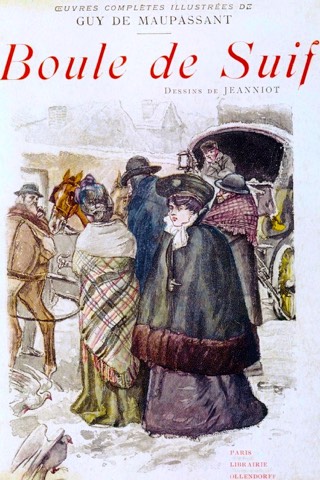
Boule de Suif
Guy de Maupassant · 1880 · ~10,500 words · level B2 · in English: Ball of Fat
During the Franco-Prussian War, a coach of respectable citizens flees occupied Rouen together with a prostitute nicknamed Boule de Suif, and their gratitude to her does not last. The story that made Maupassant famous.
Bel-Ami
Guy de Maupassant · 1885 · Chapter 1, ~5,000 words · level B2
Georges Duroy, a penniless former soldier, arrives in Paris and climbs through journalism and the beds of well-connected women. Maupassant’s novel of ambition.
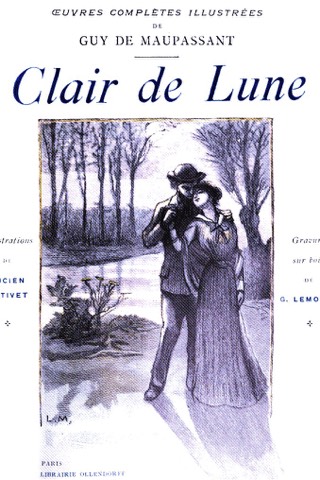
Clair de lune
Guy de Maupassant · 1884 · ~24,500 words · level B2 · in English: Moonlight
Three stories from Maupassant’s collection: “Clair de lune”, in which a priest who distrusts women sets out to catch his niece with her lover, “Conte de Noël” and “Mademoiselle Cocotte”.
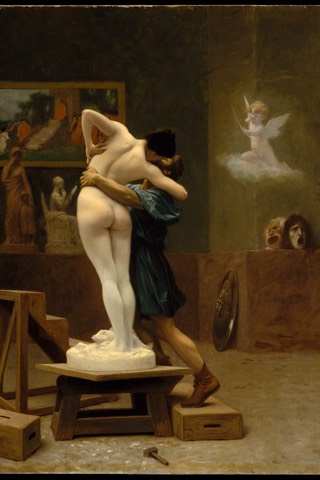
La Vénus d'Ille
Prosper Mérimée · 1837 · ~10,500 words · level B2–C1 · in English: The Venus of Ille
An antiquarian visits a village in Roussillon where a bronze Venus has just been dug up, a few days before his host’s son is to be married. Mérimée’s tale of the fantastic, told with a straight face.