La Bête humaine in French, with English translation
Émile Zola · 1890 · Opening, ~687 words · level C1
In a room overlooking the Gare Saint-Lazare, the deputy station-master Roubaud waits for his wife. Before the afternoon is over he has learned something that leads to a murder on the Paris–Le Havre line.
Add the whole book to your wishlist Only the opening is ready so far. Free: the books readers ask for most are the next ones we prepare in full. Read the opening in Lexico.The opening, as you read it in Lexico
The first 700 words of the French text. Tap any sentence for its English translation, then any word for its meaning: that is what the app does on every page.
En entrant dans la chambre, Roubaud posa sur la table le pain d'une livre, le pâté et la bouteille de vin blanc. Mais, le matin, avant de descendre à son poste, la mère Victoire avait dû couvrir le feu de son poêle, d'un tel poussier, que la chaleur était suffocante. Et le sous-chef de gare, ayant ouvert une fenêtre, s'y accouda.
Entering the room, Roubaud set the pound loaf of bread, the pâté and the bottle of white wine on the table. But in the morning, before going down to her post, Mother Victoire had had to bank the stove fire with such coal dust that the heat was stifling. And the assistant stationmaster, having opened a window, leaned on his elbows there.
C'était impasse d'Amsterdam, dans la dernière maison de droite, une haute maison où la Compagnie de l'Ouest logeait certains de ses employés. La fenêtre, au cinquième, à l'angle du toit mansardé qui faisait retour, donnait sur la gare, cette tranchée large trouant le quartier de l'Europe, tout un déroulement brusque de l'horizon, que semblait agrandir encore, cet après-midi-là, un ciel gris du milieu de février, d'un gris humide et tiède, traversé de soleil.
It was the dead end of the Impasse d'Amsterdam, in the last house on the right, a tall building where the Compagnie de l'Ouest housed some of its employees. The window, on the fifth floor, at the corner of the mansard roof that turned back, looked out over the station, that broad cutting slicing through the Europe district, a sudden sweep of horizon which, that afternoon, a grey mid-February sky, damp and mild and streaked with sunshine, seemed to make even wider.
En face, sous ce poudroiement de rayons, les maisons de la rue de Rome se brouillaient, s'effaçaient, légères. A gauche, les marquises des halles couvertes ouvraient leurs porches géants, aux vitrages enfumés, celle des grandes lignes, immense, où l'oeil plongeait, et que les bâtiments de la poste et de la bouillotterie séparaient des autres, plus petites, celles d'Argenteuil, de Versailles et de la Ceinture; tandis que le pont de l'Europe, à droite, coupait de son étoile de fer la tranchée, que l'on voyait reparaître et filer au-delà, jusqu'au tunnel des Batignolles. Et, en bas de la fenêtre même, occupant tout le vaste champ, les trois doubles voies qui sortaient du pont, se ramifiaient, s'écartaient en un éventail dont les branches de métal, multipliées, innombrables, allaient se perdre sous les marquises. Les trois postes d'aiguilleur, en avant des arches, montraient leurs petits jardins nus. Dans l'effacement confus des wagons et des machines encombrant les rails, un grand signal rouge tachait le jour pâle.
Opposite, under this shimmering haze of light rays, the houses of Rome Street blurred and faded, light and airy. To the left, the covered market halls opened their giant porches with smoke-stained glazing, the main-line one immense, where the eye plunged, and which the post office and boiler house buildings separated from the others, smaller ones, those of Argenteuil, Versailles and the Ceinture; while the Europe bridge, on the right, cut its iron star across the cutting, which could be seen reappearing and running on beyond, as far as the Batignolles tunnel. And, at the foot of the window itself, filling the whole vast field, the three double tracks coming out from the bridge branched out and spread apart into a fan whose metal branches, multiplied and countless, were going to vanish under the canopies. The three signal boxes, in front of the arches, showed their small bare gardens. In the hazy blur of wagons and engines cluttering the rails, a large red signal stained the pale daylight.
Pendant un instant, Roubaud s'intéressa, comparant, songeant à sa gare du Havre. Chaque fois qu'il venait de la sorte passer un jour à Paris, et qu'il descendait chez la mère Victoire, le métier le reprenait. Sous la marquise des grandes lignes, l'arrivée d'un train de Mantes avait animé les quais; et il suivit des yeux la machine de manoeuvre, une petite machine-tender, aux trois roues basses et couplées, qui commençait le débranchement du train, alerte besogneuse, emmenant, refoulant les wagons sur les voies de remisage. Une autre machine, puissante celle-là, une machine d'express, aux deux grandes roues dévorantes, stationnait seule, lâchait par sa cheminée une grosse fumée noire, montant droit, très lente dans l'air calme. Mais toute son attention fut prise par le train de trois heures vingt-cinq, à destination de Caen, empli déjà de ses voyageurs, et qui attendait sa machine. Il n'apercevait pas celle-ci, arrêtée au-delà du pont de l'Europe; il l'entendait seulement demander la voie, à légers coups de sifflet pressés, en personne que l'impatience gagne. Un ordre fut crié, elle répondit par un coup bref qu'elle avait compris. Puis, avant la mise en marche, il y eut un silence, les purgeurs furent ouverts, la vapeur siffla au ras du sol, en un jet assourdissant. Et il vit alors déborder du pont cette blancheur qui foisonnait, tourbillonnante comme un duvet de neige, envolée à travers les charpentes de fer. Tout un coin de l'espace en était blanchi, tandis que les fumées accrues de l'autre machine élargissaient leur voile noir. Derrière, s'étouffaient des sons prolongés de trompe, des cris de commandement, des secousses de plaques tournantes. Une déchirure se produisit, il distingua, au fond, un train de Versailles et un train d'Auteuil, l'un montant, l'autre descendant, qui se croisaient.
For a moment, Roubaud became interested, comparing and thinking of his station at Le Havre. Each time he came to spend a day in Paris this way, and stayed at Mother Victoire's, the work would take hold of him again. Under the main-line canopy, the arrival of a Mantes train had enlivened the platforms; and he watched the shunting engine with his eyes, a small tank engine with three low coupled wheels, which was beginning to uncouple the train, busy and alert, hauling and pushing the wagons onto the storage sidings. Another engine, powerful this one, an express engine with two large devouring wheels, stood alone, letting out a thick black smoke through its chimney, rising straight up, very slow in the calm air. But all his attention was taken by the three twenty-five train for Caen, already full of its passengers, and which was waiting for its engine. He could not make out that one, stopped beyond the Europe bridge; he only heard it asking for the track with short, hurried whistle blasts, like someone overtaken by impatience. An order was shouted; it answered with a short blast which meant it had understood. Then, before starting up, there was a silence, the drains were opened, and the steam hissed close to the ground in a deafening jet. And he then saw that white mass billowing from the bridge, swirling like a down of snow, blown away through the iron framework. A whole corner of the space was whitened by it, while the increased smoke of the other engine widened its black veil. Behind, horn blasts that were prolonged, shouts of command and jolts of turntables were being stifled. A gap opened up; he made out, at the far end, a Versailles train and an Auteuil train, one going up and the other coming down, passing each other.
Comme Roubaud allait quitter la fenêtre, une voix qui prononçait son nom, le fit se pencher. Et il reconnut, au-dessous, sur la terrasse du quatrième, un jeune homme d'une trentaine d'années, Henri Dauvergne, conducteur-chef, qui habitait là en compagnie de son père, chef adjoint des grandes lignes, et de ses soeurs, Claire et Sophie, deux blondes de dix-huit et vingt ans, adorables, menant le ménage avec les six mille francs des deux hommes, au milieu d'un continuel éclat de gaieté. On entendait l'aînée rire, pendant que la cadette chantait, et qu'une cage, pleine d'oiseaux des îles, rivalisait de roulades.
As Roubaud was about to leave the window, a voice calling his name made him lean out. And he recognized, below, on the fourth-floor terrace, a young man of about thirty, Henri Dauvergne, chief conductor, who lived there with his father, deputy chief of the main lines, and his sisters Claire and Sophie, two blondes of eighteen and twenty, adorable, running the household with the six thousand francs of the two men, amid a constant burst of merriment. The elder one could be heard laughing, while the younger one sang, and a cage full of birds from the islands vied in trills.
Want the rest? Lexico has the opening of La Bête humaine so far. Add the book to your wishlist: the titles readers ask for most are the next ones we prepare in full, with the same sentence-by-sentence translation, every word explained in context, and flashcards from the words you look up.
Add the whole book to your wishlistWords from this passage
20 words from the opening worth knowing for the rest of the book, with the meaning they have here.
| French | English |
|---|---|
| entrer | to enter |
| la chambre | room |
| poser | to stop carrying, to put down |
| le pain | loaf |
| la livre | pound |
| la bouteille | bottle |
| le vin | wine |
| blanc | white color |
| le matin | morning |
| le poste | job, post |
| la mère | mother |
| devoir | must, to have to |
| couvrir | to cover up, to cover |
| le feu | fire |
| le poêle | stove |
| le poussier | coal dust |
| la chaleur | heat |
| suffocant | stifling |
| le sous-chef | assistant stationmaster |
| accouder | to rest, lean |
More French books with English translation
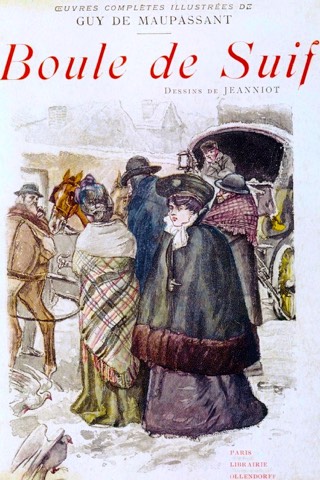
Boule de Suif
Guy de Maupassant · 1880 · ~10,500 words · level B2 · in English: Ball of Fat
During the Franco-Prussian War, a coach of respectable citizens flees occupied Rouen together with a prostitute nicknamed Boule de Suif, and their gratitude to her does not last. The story that made Maupassant famous.
Bel-Ami
Guy de Maupassant · 1885 · Chapter 1, ~5,000 words · level B2
Georges Duroy, a penniless former soldier, arrives in Paris and climbs through journalism and the beds of well-connected women. Maupassant’s novel of ambition.
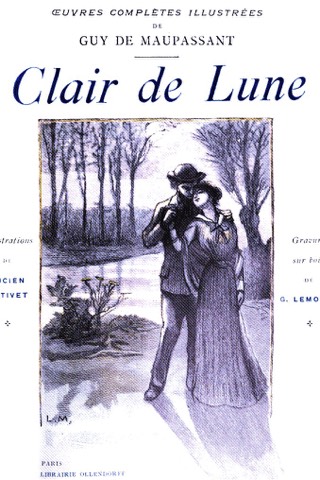
Clair de lune
Guy de Maupassant · 1884 · ~24,500 words · level B2 · in English: Moonlight
Three stories from Maupassant’s collection: “Clair de lune”, in which a priest who distrusts women sets out to catch his niece with her lover, “Conte de Noël” and “Mademoiselle Cocotte”.
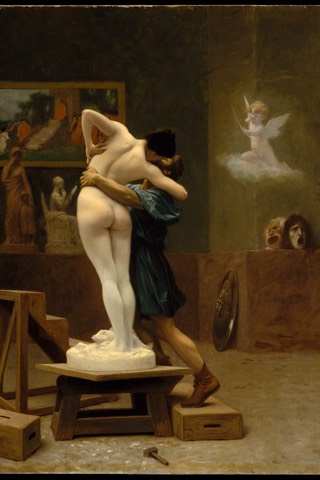
La Vénus d'Ille
Prosper Mérimée · 1837 · ~10,500 words · level B2–C1 · in English: The Venus of Ille
An antiquarian visits a village in Roussillon where a bronze Venus has just been dug up, a few days before his host’s son is to be married. Mérimée’s tale of the fantastic, told with a straight face.