
Germinal in French, with English translation
Émile Zola · 1885 · Opening, ~666 words · level C1
On a freezing March night an out-of-work mechanic, Étienne Lantier, walks across the black plain of northern France to the Voreux coal mine. Zola’s novel of the miners and their strike.
Add the whole book to your wishlist Only the opening is ready so far. Free: the books readers ask for most are the next ones we prepare in full. Read the opening in Lexico.The opening, as you read it in Lexico
The first 650 words of the French text. Tap any sentence for its English translation, then any word for its meaning: that is what the app does on every page.
Dans la plaine rase, sous la nuit sans étoiles, d'une obscurité et d'une épaisseur d'encre, un homme suivait seul la grande route de Marchiennes à Montsou, dix kilomètres de pavé coupant tout droit, à travers les champs de betteraves. Devant lui, il ne voyait même pas le sol noir, et il n'avait la sensation de l'immense horizon plat que par les souffles du vent de mars, des rafales larges comme sur une mer, glacées d'avoir balayé des lieues de marais et de terres nues. Aucune ombre d'arbre ne tachait le ciel, le pavé se déroulait avec la rectitude d'une jetée, au milieu de l'embrun aveuglant des ténèbres.
In the flat plain, under the starless night, of a darkness and a thickness like ink, a man was walking alone along the long road from Marchiennes to Montsou, ten kilometres of paving stones cutting straight ahead, through the fields of beetroot. Ahead of him he could not even see the black ground, and he had the sense of the immense flat horizon only through the gusts of the March wind, wide gusts like those on a sea, icy from having swept leagues of marsh and bare land. No tree shadow stained the sky; the road stretched out with the straightness of a jetty, amid the blinding spray of the darkness.
L'homme était parti de Marchiennes vers deux heures. Il marchait d'un pas allongé, grelottant sous le coton aminci de sa veste et de son pantalon de velours. Un petit paquet, noué dans un mouchoir à carreaux, le gênait beaucoup; et il le serrait contre ses flancs, tantôt d'un coude, tantôt de l'autre, pour glisser au fond de ses poches les deux mains à la fois, des mains gourdes que les lanières du vent d'est faisaient saigner. Une seule idée occupait sa tête vide d'ouvrier sans travail et sans gîte, l'espoir que le froid serait moins vif après le lever du jour. Depuis une heure, il avançait ainsi, lorsque sur la gauche, à deux kilomètres de Montsou, il aperçut des feux rouges, trois brasiers brûlant au plein air, et comme suspendus. D'abord, il hésita, pris de crainte; puis, il ne put résister au besoin douloureux de se chauffer un instant les mains.
The man had left Marchiennes around two o'clock. He walked with a long stride, shivering beneath the thin cotton of his jacket and his velvet trousers. A small bundle, knotted in a checked handkerchief, was very much in his way; he kept pressing it against his side, now with one elbow, now with the other, so as to slip both hands at once into the depths of his pockets, numb hands that the lashes of the east wind made bleed. A single idea filled his empty head of an unemployed worker without work or lodging: the hope that the cold would be less sharp after daybreak. For an hour he had been walking like this when, on the left, two kilometres from Montsou, he caught sight of red fires, three braziers burning in the open air, and as if suspended. At first he hesitated, seized with fear; then he could not resist the painful need to warm his hands for a moment.
Un chemin creux s'enfonçait. Tout disparut. L'homme avait à droite une palissade, quelque mur de grosses planches fermant une voie ferrée; tandis qu'un talus d'herbe s'élevait à gauche, surmonté de pignons confus, d'une vision de village aux toitures basses et uniformes. Il fit environ deux cents pas. Brusquement, à un coude du chemin, les feux reparurent près de lui, sans qu'il comprît davantage comment ils brûlaient si haut dans le ciel mort, pareils à des lunes fumeuses. Mais, au ras du sol, un autre spectacle venait de l'arrêter. C'était une masse lourde, un tas écrasé de constructions, d'où se dressait la silhouette d'une cheminée d'usine; de rares lueurs sortaient des fenêtres encrassées, cinq ou six lanternes tristes étaient pendues dehors, à des charpentes dont les bois noircis alignaient vaguement des profils de tréteaux gigantesques; et, de cette apparition fantastique, noyée de nuit et de fumée, une seule voix montait, la respiration grosse et longue d'un échappement de vapeur, qu'on ne voyait point.
A sunken lane dipped down. Everything vanished. The man had on his right a fence, some wall of thick planks enclosing a railway line; while on the left a grassy embankment rose, topped by indistinct gables, a vision of a village with low, uniform roofs. He took about two hundred paces. Suddenly, at a bend in the road, the fires reappeared near him, without him understanding any better how they could burn so high in the dead sky, like smoky moons. But at ground level, another sight had just stopped him. It was a heavy mass, a crushed jumble of buildings, out of which rose the silhouette of a factory chimney; a few dim lights came from the grimy windows, five or six sad lanterns hung outside from framework whose blackened timbers vaguely outlined giant trestles; and from this fantastic apparition, drowned in night and smoke, came a single voice, the deep, long breath of a steam exhaust that could not be seen.
Alors, l'homme reconnut une fosse. Il fut repris de honte: à quoi bon? il n'y aurait pas de travail. Au lieu de se diriger vers les bâtiments, il se risqua enfin à gravir le terri sur lequel brûlaient les trois feux de houille, dans des corbeilles de fonte, pour éclairer et réchauffer la besogne. Les ouvriers de la coupe à terre avaient dû travailler tard, on sortait encore les débris inutiles. Maintenant, il entendait les moulineurs pousser les trains sur les tréteaux, il distinguait des ombres vivantes culbutant les berlines, près de chaque feu.
Then the man recognized a pit shaft. He was seized with shame: what good was it? There would be no work. Instead of heading for the buildings, he finally ventured to climb the slag heap on which the three coal fires were burning, in cast-iron baskets, to light and warm the work. The workers from the surface cutting had had to work late; they were still bringing out the useless debris. Now he could hear the wagon-pushers shoving the trains onto the trestles; he made out living shadows tipping the wagons near each fire.
—Bonjour, dit-il en s'approchant d'une des corbeilles.
"Good morning," he said, approaching one of the baskets.
Tournant le dos au brasier, le charretier était debout, un vieillard vêtu d'un tricot de laine violette, coiffé d'une casquette en poil de lapin; pendant que son cheval, un gros cheval jaune, attendait, dans une immobilité de pierre, qu'on eût vidé les six berlines montées par lui. Le manoeuvre employé au culbuteur, un gaillard roux et efflanqué, ne se pressait guère, pesait sur le levier d'une main endormie. Et, là-haut, le vent redoublait, une bise glaciale, dont les grandes haleines régulières passaient comme des coups de faux.
Turning his back to the fire, the carter was standing, an old man wearing a purple wool jacket and a rabbit-fur cap; while his horse, a big yellow horse, waited, motionless as stone, until one had emptied the six wagons he had hauled. The laborer working the tipper, a red-haired, scrawny fellow, was in no hurry, pressing on the lever with a sleepy hand. And up above, the wind redoubled, an icy gust, whose great regular breaths swept past like scythe strokes.
—Bonjour, répondit le vieux.
"Good morning," the old man replied.
Un silence se fit. L'homme, qui se sentait regardé d'un oeil méfiant, dit son nom tout de suite.
A silence fell. The man, feeling himself watched with a distrustful eye, said his name at once.
—Je me nomme Étienne Lantier, je suis machineur... Il n'y a pas de travail ici?
"My name is Étienne Lantier, I'm a machinist... Is there no work here?"
Les flammes l'éclairaient, il devait avoir vingt et un ans, très brun, joli homme, l'air fort malgré ses membres menus.
The flames lit him up; he must have been twenty-one, very dark-haired, a handsome fellow, looking strong despite his slender limbs.
Want the rest? Lexico has the opening of Germinal so far. Add the book to your wishlist: the titles readers ask for most are the next ones we prepare in full, with the same sentence-by-sentence translation, every word explained in context, and flashcards from the words you look up.
Add the whole book to your wishlistWords from this passage
20 words from the opening worth knowing for the rest of the book, with the meaning they have here.
| French | English |
|---|---|
| la plaine | plain |
| ras | flat |
| la nuit | night |
| l’étoile | star |
| l’obscurité | darkness |
| l’épaisseur | thickness |
| l’encre | ink |
| suivre | to follow |
| grand | great (here: main) |
| la route | road |
| le kilomètre | kilometre / kilometer |
| le pavé | pavé (here: paving) |
| coupant | cutting |
| droit | ahead |
| le travers | across |
| le champ | vector field, tensor field |
| la betterave | beet |
| voir | to see |
| le sol | ground |
| noir | black, of black ethnicity |
More French books with English translation
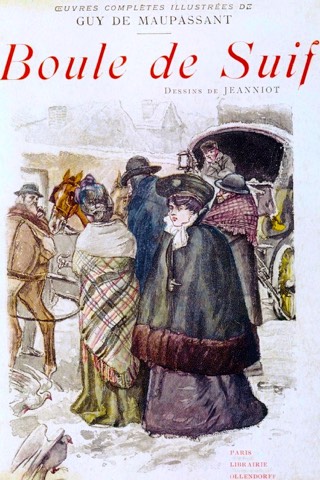
Boule de Suif
Guy de Maupassant · 1880 · ~10,500 words · level B2 · in English: Ball of Fat
During the Franco-Prussian War, a coach of respectable citizens flees occupied Rouen together with a prostitute nicknamed Boule de Suif, and their gratitude to her does not last. The story that made Maupassant famous.
Bel-Ami
Guy de Maupassant · 1885 · Chapter 1, ~5,000 words · level B2
Georges Duroy, a penniless former soldier, arrives in Paris and climbs through journalism and the beds of well-connected women. Maupassant’s novel of ambition.
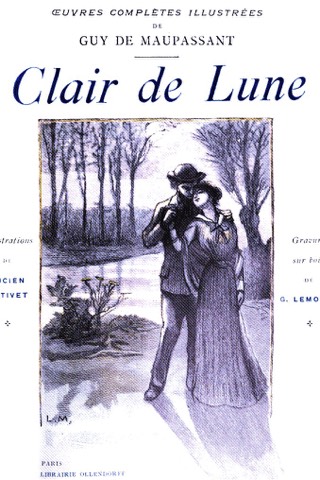
Clair de lune
Guy de Maupassant · 1884 · ~24,500 words · level B2 · in English: Moonlight
Three stories from Maupassant’s collection: “Clair de lune”, in which a priest who distrusts women sets out to catch his niece with her lover, “Conte de Noël” and “Mademoiselle Cocotte”.
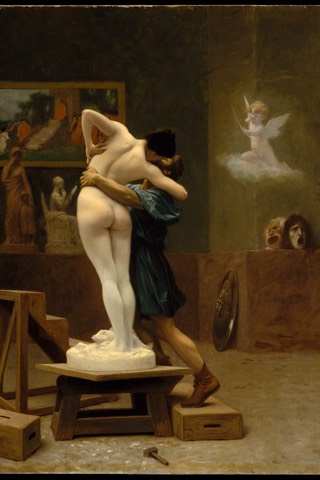
La Vénus d'Ille
Prosper Mérimée · 1837 · ~10,500 words · level B2–C1 · in English: The Venus of Ille
An antiquarian visits a village in Roussillon where a bronze Venus has just been dug up, a few days before his host’s son is to be married. Mérimée’s tale of the fantastic, told with a straight face.